Thursday, March 7, 2013

Social Media and the Alcoholic Beverage Industry

This is a post I've been meaning to write for awhile and now I finally have the impetus to do it. Being part of the IBM My Smarter Commerce program for (almost) the past month has left me with a lot of thoughts. Aside from the self-depreciating ones like "why did they pick me?" and "what do I have to offer?" and "why am I talking to myself in my room?", the biggest one is "what is good social media and what has it done for me?" And then I realize.

It's built my brand. Or whatever you want to call In With Bacchus at this point.

The more I think about it, the more I realize that without Twitter, I don't think I'd be half as known as I am now and a quarter as popular as I am (maybe I'm exaggerating those two numbers but I'm just gonna say that they're small to begin with). It's allowed me to do so many things with so little monetary investment. When I first started this website, I had no Twitter followers and it was just a way for me to write down what I liked and didn't like. Now I have 3000+ followers and people actually listen to me. LISTEN TO ME! HOW WEIRD IS THAT?! But how? And why? After a month's worth of thinking, of ruminating, of pondering...I think I got it. The key is twofold: good social media practices and interfacing. Here's how they work.


What Is Good Social Media?

First off, what is good social media? I'm not talking about "what's your favorite platform". I'm talking about how it's used. For me, this ties directly into what I love so much about the beverage industry. You see, even the most industrial spirit...require something special. They require hands on. Hands on is a big thing for me. So many places these days don't make anything anymore. They ship it out, the automate it, they streamline it. But for the majority of the alcoholic beverage industry...that's just not how it goes. Sure, you may have your rectified spirits cut down to make vodka. But at the heart of that are a few guys and gals who check the grain in the grain quality office and decide whether or not its suitable for ethanol production. There are the guys and gals that mill the grain. The people that pump the grain into the mashing vats. The people that pump the water in. The people that check the strike temperatures of the water going in to make sure the enzymes convert the starches to sugars. The men and women that work in the yeast propagation labs, mixing proprietary yeast strains into nutrient media and letting the yeast divide and conquer its way to volumes suitable for fermentation. There are the men and women that dump the yeast and and watch that fermentation. The men and women that fabricate the short, squat pot stills or the stories tall column stills. All of it requires hands on. It's just the nature of the beast. No matter how industrial a company gets...there's always someone there checking, watching, waiting, and using their experience to guide the process to a better product. And that's amazing.

It is no coincidence that good social media programs should be the same way. If you follow me on Twitter (if you don't you should), you know that I spend a majority of my day on Twitter. I love Twitter because it allows me to have hundreds, thousands of micro-conversations in real time with people all across the world on topics I love. Whisk(e)y, gin, cigars, pipe tobacco, you name it. There are people out there that I get to talk to about anything I want and that's super cool. And I get involved. I get hands on. I don't send out blanket Tweets (well, very, very rarely I do), I engage people in one-to-one or small conversations, I answer questions and pose new ones. I treat it like a conversation. That's what people and companies do wrong. A lot of people complain that "Twitter is all Tweets about what people ate for lunch." Yeah, you get those. But fundamentally...that's what you want. You want it to be personal. You want to put yourself out there, get your hands dirty, and use your knowledge and expertise to put your spin on things. Everybody's got something their passionate about. EVERYBODY. You may not think it but there's something out there that when someone mentions it your eyes light up and you start to talk faster. Everybody's got it. Twitter is where you should flaunt it. Where people (mostly companies) go wrong is when they don't share that passion. They don't interact. Blanket Tweets, shilling ads, funny PR quips...they're not good. They don't add anything to the conversation that is Twitter, they just clutter it up. Are you someone super excited about plastic molding? I'm sure there's people out there on Twitter that would gladly listen to what you have to say. But you NEED to get involved. I've seen so many businesses and brands START on Twitter and become successful on Twitter just because they interact, they converse, they hang out in the e-cafe that is Twitter. And that's cool. It also brings me to my next point.


How Does It Help?

The alcoholic beverage industry is MASSIVE. It's more massive than you can possibly imagine and in ways you may not understand. Sure, you have your large companies in the alcoholic beverage industry. They produce dozens of brands, if not hundreds. That's fine and dandy. But there's also the little guys as well. The small production, locally sourced guys. The mom-and-pops of the liquor industry, I guess you could say. And this is where social media shines.

Over the course of the 4 years I've spent on Twitter, I've ran into so many brands NOT associated with large companies its staggering. I've talked with them on Twitter and watched them grow. Imbue Vermouth, Cro Magnon Cigars, Dr. Adam Elmegirab's Bitters, Drew Estate Cigars. I've been able to interface with these brands and watch their growth as I've puttered along on the blog. Twitter is amazing for smaller brands to directly interface with their consumers and get their sweet, sweet liquor and cigars into my mind. I think about them. I want them. They maybe thousands of miles away from me and all they really have is a website and a bunch of stores that sell them but the fact of the matter is is that I've talked to the people that own them, that make their stuff, and had conversations with them. We've chatted. Kind of a big deal. I dunno, I find this part especially hard to put into words. The first part is easier because it reflects what I love about my industry but this part has that certain je ne sais quoi about it. It's awe inspiring to watch brands grow on a social media platform. Using the ability to say "Hey, what about our stuff" in an era of massive advertisements for big brand products is pretty cool. Being able to talk to the people making the stuff is even cooler. And the fact that I can do it at 2am in my sweatpants is probably the best part. But shhh, don't tell anyone that.

Friday, February 22, 2013

Old Rip Van Winkle Combines Releases

So there I am, minding my own business, playing Minecraft, when a friend logs on and drops some knowledge. This knowledge:
We had been speculating about what was going to happen for some time now. He had said that there was a possibility that there would be a condensing of Van Winkle releases or they might not even do a spring release. Normally, I'm relatively unfazed by this as I can't afford any Van Winkle stuff. It's extremely hard to find and if you can find it, it's expensive and/or got a rarity premium on it. And for someone who's on unemployment...that's a no-brainer in the no-buy area. However, as of late its been something of an intrigue for me at this point. With the reopening of the Stitzel-Weller distillery by another company...I'm rather fascinated by this decision. Do I think it will mean more Pappy for the US?

No, no I don't.

You have to understand that the Van Winkle family has been blending their bourbon with stock from Buffalo Trace for a bit now. The fact of the matter is is...well...there's only so much Stitzel-Weller juice to go around. More can't magically appear. I'm VERY sure there's no hidden barrels of Pappy lying around because they've probably got a private detective PLATOON on the case looking for anything and everything that they can bottle from the old distillery. No, I don't think it will mean that there will be more Pappy.

I actually think there'll be less.

One of the funny things about delaying or combining releases is that it's rarely because there's MORE coming out that they're waiting on. It usually means that they're waiting for LESS to be ready. I think that we'll see larger bursts of Pappy...more cases going out at a time than usual...but less OVERALL. This collapsing of the releases means that they can sit around and wait a year in-between releases to keep an eye on the barrels, as opposed to every six months. Six months in Kentucky heat can do wonders...but a year can do even more. Barrels that might not be "ready" yet (I say this loosely as you're talking about extremely old whiskey as it is) can get the benefit of a bit more time to mature and, say, gain a bit more blending edge for mixing with Buffalo Trace stock. Enough to replicate the Stitzel-Weller character when cut with Buffalo Trace 15, 20, or 23 year old bourbon. To me, this is a sign that the Pappy line will be changing and probably soon. Maybe within the next three years. I'm not sure if they can hold out on that flavor profile with the dwindling reserves of Stitzel-Weller.

But that's just a young, naive man's thoughts.

Tuesday, February 19, 2013

NY Wine Expo (Coupons Inside!)

Hey all!

I'm sure that at least a few have noticed lately my enthrallment with wine. For the longest time I was drinking cheap, rough Chianti and, after a few wine tastings I attended, I realized that I'd been missing out. Greatly.

Seriously, wine is really good! It's not just cheap Italian heartburn juice. I promise.

So what do you do when you want to try a bunch of wine? You attend a wine expo. Specifically, this one:


I will be covering the NY Wine Expo at the Javits Center in NYC from the 1st - 3rd of March. Sounds cool, huh? Well, it gets better. You can attend too. Don't want to pay the $85 or $95 for the ticket? Don't worry, homeskillet, I got yo back! Until the 28th, you can use the promo code "VINO" for some sweet sweet discounts. 10% off? Nope. 12%? Noooope. You're looking at a whopping $15 off the top of each ticket for Friday and Saturday. Sweet, huh? You know I love ya so I do what I can.

Now, I will probably be attending on the Trade day. However, if you guys can convince me to go either Friday or Saturday and swirl some wine with some readers...I'll change the day. BUT YA GOTTA PERSUADE ME. Valid forms of payment are: cash, pork buns, scotch, bottles of wine, cigars. Anyway, here's the press release to give you a taste of what's going down. So, until the 3rd of March, get your tastebuds ready for some hot grape-on-grape action.

Press Release (rare, I know)
Raise a glass in celebration! The New York Wine Expo is celebrating its 6th anniversary, March 1-3, 2013. With only their wine glasses and taste buds to lead them, attendees can travel through the vineyards of Europe and the Mediterranean; from South America
to South Africa; and coast to coast in the United States. In all, attendees will have the opportunity to
choose from a sampling of over 500 wines. The 6th annual New York Wine Expo is at the Jacob Javits
Convention Center in New York City.

“The Expo is truly a feast for the senses, with wines from every corner of the world represented,”
said Ed Hurley, Marketing Director, ResourcePlus Shows & Events. “For anyone who enjoys
wine or is a beginner and wants to learn, a day at the Expo is a deliciously fun way to spend time
with friends and family.”

Dedicated fans know him as “Your Resident Foodie,” and this year for the first time David Venable will be joining the New York Wine Expo. As host of the hit QVC program, In the
Kitchen with David, he offers a unique interactive viewership experience and features the latest in gourmet foods, cookware, kitchen gadgets and cookbooks. Although he will not be cooking David will be conducting a “Meet & Greet” and will share wine pairing ideas.

Along with the Grand Tasting, consumers can purchase tickets to a variety of seminars led by industry experts. Additions to the seminar calendar are updated frequently. To date:

Wine 101: Taste Like a Pro with Wine Spectator’s Director of Education
Gloria Maroti Frazee
Friday, March 1st at 6:00pm | Saturday, March 2nd at 11:30am
In this seminar, attendees will build the wine appreciation framework required for a
lifetime of vinous adventure. Tasting a bounty of wine from around the world, they’ll
learn the tasting techniques used by pros, explore important grapes, identify key wine
styles and determine their own wine preferences.

The Cool Climate, World Class Wines of the Finger Lakes
Saturday, March 2nd at Noon
The Finger Lakes region of New York State has undergone an evolution in quality and
developed into a cool climate, world class wine growing region. Join Thomas Pastuszak,
Wine Director at the NoMad in New York City, for a discussion and tasting of wines
from the region. Learn about what makes the Finger Lakes the premier growing region
for cool climate grape varieties in the United States and how it compares on a global level to other regions.

Italian Cheeses and Wine with Lou DiPalo, the Cheese Guru of DiPalo’s Fine Foods
in Little Italy, NYC
Saturday, March 2, 2:30pm
Don’t miss a chance to meet this most knowledgeable and passionate advocate for
the cheeses and wines of Italy. Lou DiPalo will detail how typicity, provenance, and
maturation regimes contribute to the irresistible quality of Italian cheese. Amongst the
cheeses to be tasted will be Agriform’s Grana Padano, Piave, Asiago, and Valtellina
Casera, with Italian wines selected for pairing perfection. You will leave this informative
and tasty seminar with a bevy of expert suggestions on how best to entertain with Italian
wine and cheese.

Attendees can ensure they remember the names of every wine and wine maker they liked and lifestyle vendor they stopped by with the free New York Wine Expo mobile app. Along with notes, the app will help attendees navigate the venue, find exhibitors of interest and provide the latest event news.

Grand Tasting Pricing & Hours:

Friday, March 1, 6pm to 10pm - $85
Saturday, March 2, 1pm to 5pm - $95
Sunday, March 3, Noon to 4pm (Trade only)

Please note: Sunday, March 3 is dedicated to trade representatives. Liquor licensees from
throughout the region are invited to attend on Sunday along with attendees of the co-located International Restaurant & Foodservice Show of New York. The Wine Expo is not open to the general public on Sunday.

Sunday, February 17, 2013

In With Bacchus Guide to Whisk(e)y: Sulfur and You

The internet is funny sometimes. Especially when it comes to Twitter. Sometimes, I use Twitter for...less scholastic things. Like this:

Other times, things crop up that are interesting and relevant. Fun things! Like this:

Isn't the internet neat? Talking to the master blender for Morrison Bowmore about whisky? Social media is pretty boss. In conversation with others about whisk(e)y and sulfur, I realized that while it is widely discussed in the industry as a negative thing, many don't ask how it happens or what's done to take care of it. So, I've decided to do a bit of science jiggerypokery and present yet another super scientific case for all of you to enjoy. Presenting...The In With Bacchus Guide to Whisk(e)y: Sulfur and You!

We have to start, really, at the root of the problem. And I mean this in the most literal sense. The sulfur problem begins in barley, specifically in the root system. Sulfates found in fertilizer and in the ground are taken up into the root system of barley. They don't mean to make your whisk(e)y smelly, they really don't! The problem is, sulfur is necessary for cellular activity in plants. Two amino acids, cysteine and methionine, are critical in growth of plants. These amino acids are key in protein building within a cell. The primary culprit is cysteine.

From Wikipedia, because I'm too lazy to use ChemDraw.

Ignore most of the other stuff here and focus on that sulfur down at the bottom. Bonded to hydrogen and another carbon chain (the little weird dot thing is a carbon chain that denotes its physical orientation in a 3d plane). It is bound to a Carbon and a Hydrogen. Sulfur is an anion; it wants to take electrons from other molecules to complete itself, which is known as an ionic bond. It's oxidation state (how many electrons it wants/gives to attain stability), is usually +2. In this state, it is useful for forming anti-oxidants (important in plants as they use CO2, not O2). However...it doesn't ALWAYS do that. SOMETIMES it will form a covalent bond (where electrons are shared, not taken) with itself, known as a disulfide bond. Two cysteine will come together, chuck off their hydrogen, and bond. The best way to describe this is as such. Let's say two couples are dancing on the dance floor. Normally, the hydrogen is content to let the sulfur lead and waltz around. But sometimes, the sulfur will ditch his hydrogen partner and begin dancing with another sulfur. In this case, no one leads, they just dance. That's a rough analogy between ionic and covalent bonds.

This means that, within a cell, a bunch of cysteine will bond together to become more stable (on a singular molecule level) and, in turn, link themselves. This makes it more stable (in terms of two compounds) and also allows it to be used more efficiently in the cells themselves (catalyzing important reactions in cellular parts, giving proteins rigidity). They also can be oxidized to form a variety of sulfur acids as well. Methionine is actually catalyzed using enzymes to BECOME cysteine. So no matter how you shake it, your barley needs sulfur to function. I've glossed over a lot of the biological minute because I'm a chemical engineer and I'm terrible at it. I probably got some of this wrong but it really just serves to illustrate the ORIGIN of sulfur and why its taken in in the first place.

So we have sulfur compounds in our barley. Can't do much about that. In fermentation, the heat used to activate the enzymes in barley (alpha/beta amylase, limit dextrinase) will cause the proteins to break down. The inclusion of yeast (which too contains cysteine) will catalyze the formation of sulfides, in the form of hydrogen sulfide. A nasty little bugger. It smells like sewer gas and rotten eggs and all sorts of delightful things. No bueno for good whiskey. However, we still have a few aces in our pocket here. We know that sulfur has gotten INTO the mash...but how do we get it out? This little beauty:

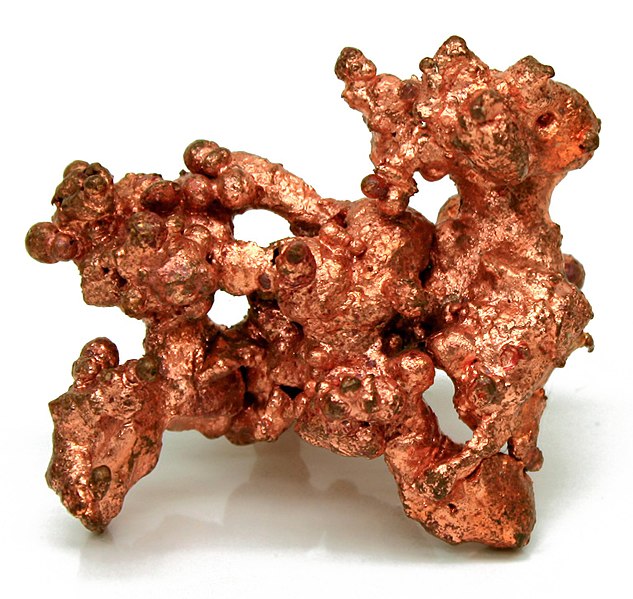
From Wikipedia...because I don't have copper lying around my house. YET.
That's right...copper. This little beauty will react with that hydrogen sulfide while in the presence of water. With a traditional oxidation state of +2 and high reactivity, it's not just good for conducting heat. In fact, it's other use is to remove sulfur. With water, (H2O), it will break that H2S to form CuSO4.

Cu 2+ + H2S --> CuS+4 + H+ 
CuS4+ + 4H2O --> CuSO4 + 8H+

Beautiful, isn't it? A simple bit of chemistry saves us a majority of headache. Okay, fine, it may not be beautiful to you but it's BEAUTIFUL TO ME! The only problem is...this isn't ALL the sulfur compounds. Its not just H2S. There's others. I mentioned it awhile ago in my barrel aging post, actually. Take a look back at that cysteine structure. Remember how I told you about that weird dotted line thing being a carbon chain? A methyl carbon chain? Also remember how I said that they will bond together with others? Well...yeah. That becomes a problem. During the heat-related breakdown of cysteine, that covalent bond might break. As the molecule breaks apart due to the heat, pieces of it will start coming apart. Its theorized that the disulfur bond will break and a methyl group will replace the sulfur on one sulfur. It can also come from said methionine as well. It forms this chemical:

Wikipedia. LAAAAAZY. Also, ChemDraw is annoying.

May not look like much but I can guarantee you've heard of it. DMS: dimethyl sulfide. It's in your favorite beers...if your favorite beers taste like cooked cabbage and corn. DMS is a particular bane to the brewing industry because there's not a whole lot you can do to get rid of it without ruining the beer. However, if any transfers over in the still...it's not too big of a problem. Why?

Barrels. GOODIE! My favorite!

The boiling point of DMS is 99oF. Rick/rackhouses can get upwards of that temperature, even in Scotland. Even in colder temperatures it will evaporate as well. As I've said before, things from high concentration like to go to low concentration. Couple that with a low boiling point and you've pretty much always got a LITTLE bit of it in vapor form in the barrel. So eventually, it will evaporate out. IF you have good casks. Casks that breathe easily, are well stored with proper temperature fluctuations, and adequate airflow is important. For the trimethyl sulfides...it takes a bit longer because the boiling point is higher so less will be in vapor. I've heard it quoted that DMS evaporates in a year~ish while the higher polymethyls will evaporate in 2-3.

So sulfur. Inevitable but, with care, can be almost completely avoided. Thankfully the flavor threshold for humans on sulfur is pretty high so it'd have to be a glaring mistake in order to catch a whiff o' the old brimstone. Or cabbage. Or sewer. Either way, I think we're fine. If you have any questions, feel free to drop me a line.
________________________________________________________________________

EDIT (3:44pm EST): Had a question from Oliver Klimek of Dramming.com. His question is as such:

"Very interesting, Scott. But there is one thing about sulphur removal that isn't quite clear yet. Distillers tell me that for getting a more sulphury spirit they try to prevent the copper from oxidisiing because CuO supposedly is more efficient than elemental copper. You only describe sulphur removal by Cu alone."

This is true. The metals that we know and love (iron, copper, tin, aluminum) aren't readily reactive in their elemental state. They form complex crystalline matrices that provide balance and stability to the metal. Each chunk of metal you see is made up of layer upon layer upon layer of grid-like metal ions. That's why they're so good at conducting heat and electrcity: its easy for electrons to flow. Much like those desktop multi-ball novelties that have you pick up a ball on one end and it transfers momentum through the other balls to move the one on the opposite end, so too is kinda how metal in its elemental state works. The problem comes when you have activation energy. Activation energy is the energy needed to break the bonds of the metal to get it to react with another chemical. Think of a roller-coaster. That long, clanking chain that brings you to the top is the activation energy; once you hit the top you just saiiiiil down. So copper in its elemental state is not prone to spontaneously and violently reacting. However...CuO means that somehow...some way, the activation energy has been provided to destabilize the elemental copper and it is now polarized. When its in this stage, it takes far, far less activation energy to get it to react again. So for a more sulfur-y spirit, you'd want clean, clean copper. It takes more oomph for it to react. For a less sulfur-y spirit, you want that metal to react because it means that it takes far less energy for it to react with subsequent elements like the sulfur.

Wednesday, February 13, 2013

The IBM #MySmarterCommerce Program

As I'm sure you know...I'm a rather social creature. I like hanging out in the Twitterverse and the Facebook...o...sphere (or whatever). It's awesome to be able to chat with people continents away about the subjects I love (whisk(e)y and cigars). It's all gravy. But I'm not a professed EXPERT at it. I'm not even adept at it. Fluent, maybe. Bumbling idiot with a keyboard and the ability to type fast is actually the most accurate. I try to converse as much as possible but I'm not perfect. I'm not optimized. I don't breathe it like guys like Gary Vaynerchuk do.

So color me surprised when my email's inbox gets blasted by a prompted for participating in a program with IBM. Only instead of surprised...it was suspicious. Call me cynical, call me pessimistic...but I actually thought it was spam. I was moments away from hitting the "Spam" button on Gmail when I decided "Well..."

I'm glad I did.

As you can PROBABLY tell at this point it wasn't spam. Either that or I'm REALLY dedicated to going through with a ruse. Pretty sure its IBM. Like 99%. 95%. Whatever. Either way, IBM selected ME...ME! to take part in their #MySmarterCommerce program. So what is this program? Well, if I told you I'd have to kill you.

Super serious here.

Can't say anything.

...Alright, I can.

The #MySmarterCommerce program is something that I'm actually cool with. It's the use of normal, every day people to tell their story of how they interface with technology. How it helps them live daily, work daily, function normally. This has been a topic I'd wanted to go into at some point but never had the motivation or focus to do. It's a heavy, lofty, and hefty tome of analysis that I generally save for over pints or a good cocktail. But instead, I've decided to take part in this and share it with you, instead of my long-suffering friends whom I'm not entirely sure are capable of bearing any more of my nerdy beverage industry analysis.

So here's how it works: I put up posts...and Tweets, and Facebook stuff about my relation with technology and social media and how it works for me. IBM waves its fingers and makes magic happen. I don't get much for doing this at first but if you guys pull through with me, we can be on the winning team that sees me on stage telling my story at SXSW. And if you're a booze geek or a cigar nerd like me...you WANT to see me on stage repping our collective nerdiness to the SXSW masses. YOU WANT THAT, I SWEAR.

As things go along...they get serious. Game faces get put on and someone breaks out the boot polish and puts those weird stripes under their eyes. Seriously, what's with that stuff? I heard it prevents reflection from the sun from blinding but all I can think it does is smear uncomfortably into your eyes. Anyway, the serious bit comes in when they follow me around with a camera. That's right, In With Bacchus: The TV Show. You get to see my lovely face.

Stop laughing.

After that, I don't know. Things get crazy, I think. Maybe lavish parties at mansions...helicopters full of gold bullion...Ferraris full of Pliny the Younger and and trunks full of cigars. At least that's what I'm hoping. But I can't do it without you fine folks. So join in and let's rock this.

NOTE: This is a sponsored post from IBM. They haven't given me anything YET...but they will. I don't know what it is yet. Maybe it's the gold bullion I was talking about. In all likelihood, it will probably be products, access, content, or any other form of reward or remuneration. As has ALWAYS been the cast, the opinions here are honest (usually brutal) and all mine. I have also chosen the most unobtrusive banner I can. <3 you guys.