Friday, December 30, 2011

Steam Holiday Sales

I'm sure, by this point, you know how much I love to play video games. There is nothing better in this world than a LAN party. Few things equal sitting down with a tall glass of good whisk(e)y and some Skyrim. I'm not afraid to say it. I'm a gamer. Wannafightaboutit?

Unfortunately, games cost money. Well, legitimate games cost money and I'm a man of the law. You should know this because I never buy Cuban products. Ever. While I make a solid amount at Tuthilltown, most of it goes to ancillary bills and related costs. Seriously, gas is so damn expensive. What's the deal with that? They're just decayed dinosaurs. Let's compress some garbage and make more oil. Problem solved.

Anyway, Steam has decided to royally screw with me for not just a few days but, like, two solid weeks. The Steam Holiday Sales cause much strife to my wallet so I have decided to do something about it. If you don't follow me on Twitter, awhile back, while I was writing my thesis, I would write people 1000 word stories provided they gave me the first sentence and an email to send it to. I would do this for free because I love you. And people really enjoyed their stories. Here is an example of one of the stories I wrote:


    He knew they were in trouble when he found out the penguins had got into the whiskey.  The long days guarding the penguin pen from inquisitive children and particularly light-fingered teens had taken their toll on him. It was a bottle of blended scotch he kept in the feeding room, tucked behind some of the multiple buckets they usually filled with herring to throw at the little bastards. He didn’t even care if it smelled like fish when he drank it. But now the cat was out of the bag. And in the stomach of a dozen penguins.
    It was our job to do clean-up on this. Shannon has a degree in Marine Biology which, frankly, means she‘s frighteningly overqualified for this kind of grunt work. I went to college for a degree in English. That’s how I ended up being a professional penguin wrangler. You wouldn’t think that twenty years after I proudly exclaimed, at three years old, that I would be a scientist that you’d find me standing knee deep in water in a penguin habitat. I think Shannon only does it because she likes to watch them waddle. The water was frigid and smelled like decomposing fish and I‘m really regretting my life choices. But I had an apartment that required rent and a belly that constantly required food. So here I am, wrangling penguins.
    Normally, it’s not too hard to wrangle penguins. There’s a variety of tricks you can use to lure them into the cages they transport them to the vets in. A tried and true method, as cartoony as it sounds, is a fish on a stick. Penguins love fish and aren’t known for their agility on land. You just have to slowly amble along slightly faster than those little tuxedo’d wretches, holding out that stick, and they’d plod their way into the cage after awhile. The other method is a bit more tricky. Catching a penguin is no small feat. They may not be fast on land but they’re slippery little devils and, once the get into the water, it’s nigh impossible to catch one of them. At that point you just have to wait for them to tire out and nab them when they pass out. But drunk penguins…
    I’m wading around in the water trying to get these drunken little buffoons to swim in Shannon’s general direction so she can catch them with a pool skimmer. They’re amazingly drunk and are having a hard time not just swimming straight but thinking straight as well. Two of them are in the corner, fighting over absolutely nothing. Another one is just standing at the glass wall, staring at the children who are laughing at what must be the best day of their young lives. Two grown adults, chasing after penguins. A child’s dream come true.
    I catch one as it wobbles around like a poorly made top. It flops around like a beached fish and I put it into the cage. Behind me, I hear another penguin throw up. I didn’t know penguins could throw up. Did you? Well, they can. And the smell of scotch soaked fish is not a pleasant one. The zookeeper tells me that the bottle fell into a bucket of fish early last night after closing and the fish marinated in their ethanol bath overnight. The smell of the fish covered the alcohol and, after morning breakfast, there were some mighty inebriated penguins. Another penguin swims close to me and, by sheer luck, I scoop it out of the water and put it into a cage. It stares at me with it’s beady little eyes. If it could, it would try to fight me with a broken bottle. I can see it.
    Hour after painful hour we spend in that enclosure, pursuing our little web-footed prey. You’d think you’d catch one but the water slicked skin would just bounce off your rubber gloves. You’d get them cornered and they’d panic like sheep, bolting in different directions and it would be back to trying to corral them again. The last one just gave up. I’m pretty sure it was hung over. It laid down on the ground and just let us pick it up. I kind of felt sorry for it. After I put it into the last cage, the zookeeper came over and heartily clapped us on the back. He handed us our check and we went back to the truck. I pulled off the rubber gloves and looked at the check. $150.

I’m going back to school.


So yeah. Now, thanks to Steam (blame them), I gotta charge $5 for 'em. So follow me on Twitter because that's where the magic happens. Whenever the Steam Holiday Sales for the day come out (usually at 1pm EST), I take a look through them. If there's some games I want, I calculate how many stories it'll cost and I'll put a post up on Twitter. Probably on Facebook too. You message me / DM me the first line of the story and an email to send it to. I send you my Paypal email (hint: its my Contact email). I write a 1000 word story in about a half hour based on the first sentence. You get literary gold (I guess?) and I get vidja games. Everybody wins. So stay tuned.

Sunday, December 11, 2011

Science of Wood Maturation

This has been a long time coming, I'll admit. And it's not that I've been putting it off, per se. It's just that it's a huge topic to broach. The science behind wood maturation is the last bastion of scientific advancement, the last frontier, of distilling science research. Even to this point, there are men and women far my superior that still don't know how reactions take place within the barrel. Me, I'm just going by what I've learned from school, good old fashioned hands-on work, and some linking of things. But, since it has been so heavily requested, I present to you:

The In With Bacchus Guide On: The Science of Wood Maturation

Wood maturation has been done, on purpose, for hundreds of years to improve taste and flavor of spirit. Realistically, probably at about the mid to late 1600s. Aging spirit really began as a happy coincidence. In the early days, most places and people preferred their spirit straight off the still. The Glenlivet that King George IV drank in Edinburgh (at that time an illicit liquor made in the hills and dales of Scotland) probably wasn't aged. At that point, distilling wasn't entirely about flavor and, hell, not even really about getting loaded. It was about not wasting things. It was easier to transport porcelain/clay jugs of new make than the equivalent acreage of barley to market. The container didn't really mean much, it was just a means of transportation. With the inception of long distance shipping (read: wooden ships) and the need for more sturdy (read: wooden) containers, barrels came into usage. Even then it was a matter of shipping and storage rather than flavor. But once barrels that had sat, slowly rocking below the decks of a ship as it sailed about Europe, people began to realize: "Wow, this tastes better." At that point, putting spirit into casks was a matter of not just necessity but of choice. Not only did it hold up under duress and travel much better but you got a tastier product out of it to boot. Everybody wins! But even though we've been intentionally putting spirit into barrels since, as said, about the dawn of the 18th century...we still didn't know WHY it was doing what it was doing. It wasn't really until the last hundred years and the advancement of analytical methodology have we discovered what happens in a cask. And we still only have an overview; a lot of the chemistry is a mystery.

What we HAVE discovered is that aging spirits can be broken down into three categories, all ending with "-tion": extraction, reaction, and interaction. Let's get to it, shall we?

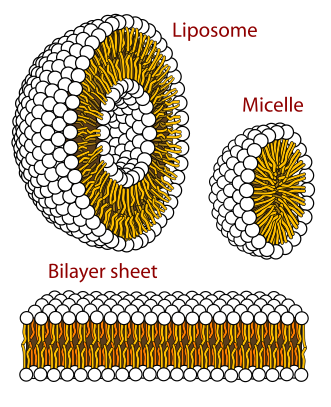
Extraction: This has to deal with the wood in a two-fold manner. To start, let's go back to the major basics and start with cellular level chemical make-ups. For us humans, our cells have what's known as a cell membrane, shown below:

Courtesy of Wikipedia
 Ignore the stuff on the top, what we want is the thing in the center. Technically the photo isn't an ACTUAL cell membrane (it's missing some parts) but it's the important part of the cell membrane: the phospholipid bilayer. It's made up of phospholipids, or long chain fats with a phosphorous atom on the end. The phosphorous is very hydrophilic, it LOOOVES water because of it and water are polar ions. The fats are hydrophobic; they HAAAAATE water because they're non-polar and water's polar. So they arrange so that the phosphorous is on the outside, near the water and the fats are on the inside. As you can see, the non-polar fats stick together on the inside (since there's water on the inside and outside of the cell) so it forms this dual layered membrane. Keep this in mind. It's
 important later.

Plant cells are different. Plant cells have a cell wall, shown below:

Courtesy of the University of Georgia.
It's made up of different stuff. No fats for these babies. What gives plants rigidity and strength is their cell wall, made up of a composition of long-chain sugars. As you can see in the above photo, the cell wall is made up of three things: cellulose, hemicellulose, and lignin. These are where we want to focus our attention.

Trees are plants so the rigidity of a barrel comes from its cell walls. Cell walls are comprised of about 45% cellulose, 30% lignin, 15% hemicellulose, and 10% other extractables. Toasting and charring the wood break down that cellulose and hemicellulose by severing bonds in them and breaking them down into smaller chain sugars that will dissolve into the spirit with time. The most quickly taken up are arabinose and glucose with fructose and xylose trailing in terms of uptake time in 55% spirit. Some of these will also breakdown into furan products (like furfural, which gives whiskey a nutty flavor). What primarily adds flavor, however, is the lignin. Lignin will break down (both by heating and by ethanolysis) into aromatic aldehydes (syringaldehyde, sinapaldehyde, coniferaldehyde, vanillin) and their counterpart acids (syringic acid, synapic acid, ferulic acid, vanillic acid). Depending on the level of toasting/charring, phenolics will be derived from the lignin as well and taken up by the ethanol. These are your guaiacyl and syringyl phenols that will give toasty, smokey flavors.

Reaction:  The reaction phase deals with evaporation and chemical reactions but this is where things kinda get weak. We know that there's a lot of chemical processes going on in the barrel but we don't really know all of it (or at least I don't). But what I do know is this. For evaporation, there is both evaporation of positive and negative attributed chemicals. For the negative aspect, the release of the polymethyl sulfides (dimethylsulfide, trimethylsulfide) that is commonly attributed to a “sulfur” smell and taste in new make evaporates. However, here is evaporation of “good” chemicals as well such as acetaldehyde, ethyl hexanoate, and acetic acid (however, the acetaladehyde / acetic acid levels are generally in equilibrium throughout maturation, meaning that the overall level upon disgorging the cask is similar to that at the very beginning). Within the reaction phase is also the aforementioned oxidation of components. Two of the key oxidation / acetal formation reactions within the cask is the transformation of acetaldehyde and acetic acid from the ethanol within the spirit. Also, the formation of dimethyl sulfoxide from dimethylsulfide (which, once again, limits the sulfur content of the final spirit). There is also esterification reactions within the barrel, such as the formation of ethyl acetate from the previously mentioned acetic acid (it can also be extracted from the wood itself as opposed to reaction with ethanol). There is also the reaction of ethanol with the aromatic aldehydes. The presence of many hydroxyl (OH) groups, afforded by the ethanol, will cause breakdowns in the aldehydes to their constituent acids and even further down the reaction chain. An example would be coniferaldehyde. In the presence of ethanol, it changes to vanillin, then vanillic acid and then to ethyl vanillate. Or sinapaldehyde, perhaps. It will change to syringaldehyde, to syringic acid, to ethyl syringate. Thus, the longer you keep it in wood, the more of these "deeper", or further progressed down the chemical reaction chain, products you get.

Interaction: The last stage is interaction. Interaction comes in two forms: pH based interactions and ethanol / water interactions. While the reactions stated above seem to be numerous and consequential, the reality is that the concentrations of the volatiles don't really change too much during maturation. Yep, dead serious. However, fluctuations in pH cause changes in the ionization states of weak bases within the spirit which affects their volatility. By changing the pKa of the solution within the cask (either by addition of acidic / basic components from the wood or the evaporation / concentration of the solution itself), the evaporative losses of some volatiles may be greatly increased. Then there's the ethanol / water interaction thing. This is where me explaining the cell membrane comes in handy. Truth be told, if you pick up a bottle of vodka, you see that it's perfectly clear and you'd probably say that the ethanol is evenly distributed within it. That if you were to pour a glass it would have as much ethanol in it as the next glass and the next glass.

You'd be wrong.

Ethanol and water are a funny pairing. They're both "polar" so they should dissolve evenly within each other. But the structure of ethanol keeps that from happening. Let's take a peek, shall we? Here's ethanol:

Courtesy of Wikipedia
Take a peek at that. You have your polar hydroxyl group on the right (the O-H, or OH group). To your left, you have your non-polar ethane group. Sounds like your phospholipids, huh? Well, you'd be right. Ethanol in concentrations above 20%, is heterogeneously distributed through the solution (unevenly distributed). What they will tend to do is form ethanol clusters. A bunch of ethanol molecules will bundle up such that their OH groups are sticking outward (the polar OH group preferring the polar water) and the ethane group sticking inward. So, above 20% ABV, this happens. And not all at once, either. This is why older spirits can taste "smoother". As time passes, these ethanol clusters become more and more compact, making the solution more and more heterogeneous. New spirits will have more of a "burning" taste because the ethanol hasn't had the time to cluster as effectively. This is also why watering down a spirit (with a mixer or whatever) makes it easier to drink. Below 20% ABV, the ethanol evenly distributes into a homogeneous mixture so you won't get random clumps of pure ethanol. When you taste it, it's like drinking a shot of 200 proof alcohol and pure water at the same time. When drinking a heterogeneous mixture, it's like taking shots of 200 proof alcohol, then a shot of water and repeating this at infinitesimally small time periods. Significantly more burning on the latter.

So there you have it. The In With Bacchus guide to the science of wood maturation. Bear in mind that I could be wrong. Distinctly possible, in all likelihood. And that this is just an overview. As said before, maturation is the final frontier of distilling science so there's constantly papers being put out about it. But only nerdy people like me constantly seek them out.


Sunday, November 13, 2011

Sweet Leaf Lemon Iced Tea - Sunday, November 13th

The Irish have a saying. Well, they have many sayings but there's one I enjoy in particular. It goes:

"What butter and whiskey will not cure, there is no cure for."

As a man (and product) of science, I should fundamentally disagree with this on all levels. Managing my anxiety takes nigh grams of anti-anxiety drugs. You could have slathered the two onto my spine for all eternity but the only thing that would have cured that was a bone saw and a skilled doctor. But still...I love this phrase. And, for maladies that don't require a doctor's intervention, I find them a potent mixture of comfort and abatement of pain. But it's missing something.

Tea.

They should change that phrase and every Brit knows to the marrow of their bones that they should. A healthy cup of tea (with or without whiskey, cream, or sugar) is a failsafe cure-all in the British Isles and I agree heartily. When I'm sick with a cold, flu, headache, or whatever, I reach for two things: over the counter medicine and a whole lot of tea.

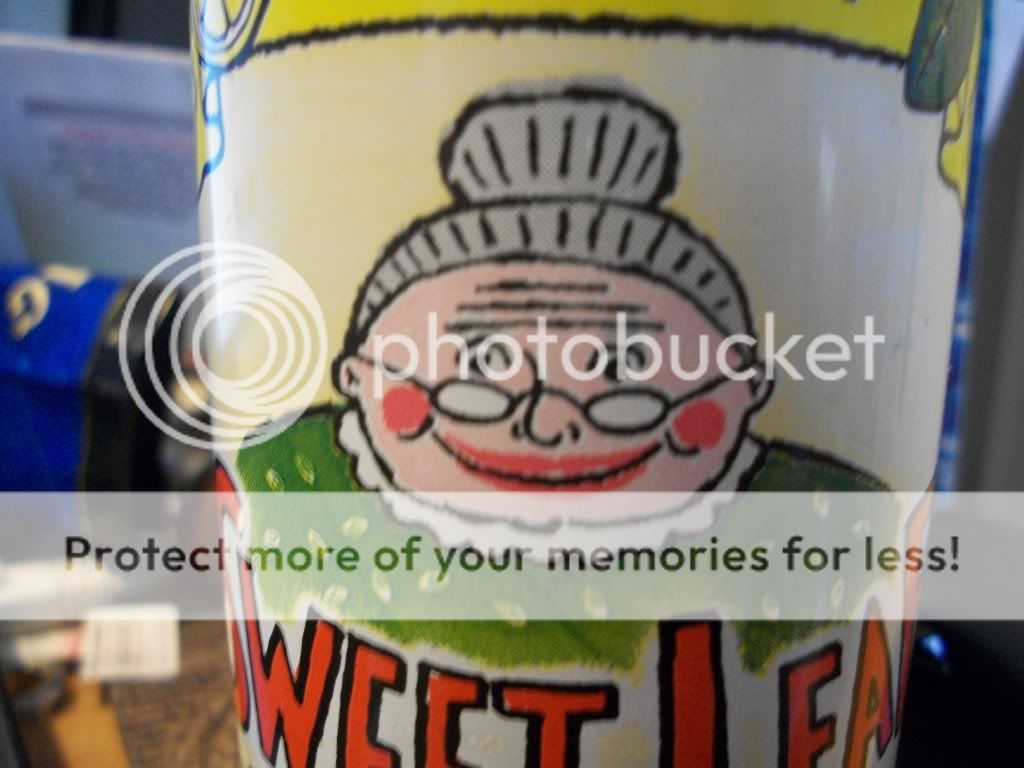
As it stands now, I'm rather sick so I've been quaffing tea down like a madman. Not the primo stuff because that would be wasted on my jam-packed nasal cavities. But cheap, strong cups of tea with milk and honey (an amended Builder's Tea) and iced tea when I'm just plain parched. I've been going through canned iced tea when I need a break from the tongue-scorching and I've been prowling the stores for new offerings. Sweet Leaf Lemon Iced Tea is NOT a new offering, however; I remember picking up a bottle of this when I was but a wee lad. Maybe my tastes have changed since then but I remember finding it not so hot back then. Nowadays, it's some pretty solid stuff. Here it is, in all the granny glory:


Frankly, this is not a can (or bottle) of tea to pick up if you have a fever or are on any significant dosage of Nyquil. That granny is SCARY. Look at that.

"They will never find your body, dearie..."
I mean, just...GAHHHHHHHH. Those eyes bore into my goddamn soul. I'm finding a trend in canned tea of ludicrous can decorations that can just be downright chilling. C'mon labeling artists. Buck up and gimme a friendly granny holding a plate of cookies (complete with heat lines coming off the top) and a glass of tea. Not Franken-Nanny.

The good news is the tea is pretty solid. They don't use HFCS or any other gross crap like that so it's a pretty easy drinker that doesn't leave your mouth like a oil slick. I'd be a bit happier if they toned down on the lemon and/or boosted the tea flavor but that's just me. I remember when I was younger I didn't like it because it wasn't sweet enough. I am downright Southern when it comes to my iced tea. I prefer an hellion brew of super strong tea cradled and swaddled in liquid diabeetus. But maybe it's my stuffy nose talking though.

Anyway, creeper granny aside, I'm feeling better already. If I put some whiskey into it and make it a buttered, fortified iced tea, I should be good in no time.

Right?

Sunday, November 6, 2011

Whisky Magazine

I know.


You were expecting this to be a post about my recent employment at Tuthilltown and what I do in the Willy Wonka shop. Well, I have to clear the article through HR before it can get posted. And before that, well, I have to write it. I was going to do that this weekend but the majority of the shocking little time I had was spent trying to find a car. I'll write it sometime this week. Maybe.


Instead, I bring equally good tidings. You will find, on page 20 of Issue 99 of Whisky Magazine (coming soon, if not already, to your local Barnes and Noble) a wee little article on craft distilling. It's titled "The Art of Craft." It's about 1500 words. Actually, it is 1478 pre-editing. How do I know these things?


I wrote it.


Yep, that's right. I've been published by Whisky Magazine. Here's a little snippet of the article:

"Distillation today is a far cry from its introduction. When distillation first started, it was done as a necessity rather than a luxury.

Completed in small batches on farms to save crops that would otherwise spoil, distillation was by no means an industrial process. Times have changed and distillation has become a multi-billion dollar business. Long gone are the days of private distillers handcrafting product in nigh miniscule volumes. Or are they? In the past 10 years, while companies like Diageo have been growing larger, a trend in the United States has been pushing to smaller.

Smaller volumes, smaller companies, and smaller stills, this trend has steadily grown to the point that it is gaining international attention. Known by many names such as craft, boutique, or farm distilling, smallscale and independent distillers free from the multinational conglomerate yoke have been cropping up across the country.

It is difficult to put a definition on exactly what a micro-distiller is and what they distill as well. The easiest way to describe them is ‘hands-on.' Many of the distillers do not have the budget to hire engineers, publicity teams, and lawyers.


Since it is so expensive to start a microdistillery, in terms of both licensing fees and equipment prices, they have to do everything independently and at minimal costs. But this independence gives them the freedom to produce whatever they desire."

That is but a mere taste of what's to come. Do you want to read the rest of this fateful chronicle? Do you desire to plumb the inky depths of beverage law and craft distilling trends? Well then, here is a step by step list of directions that will, at the end, leave you, too, with a crisply printed copy of Whisky Magazine's page 20 article by that devilishly handsome rogue Scott Spolverino:

The In With Bacchus Guide to Getting Whisky Magazine
1. Make a cup of coffee. Add cream and sugar as necessary.
2. Drink coffee. Peruse newspaper. Relax.
3. Grab keys. And cash. Or credit. Maybe even a gift certificate. But no checks. Paying for a $6.99 magazine with a check is tacky. 
4. Don't forget your Barnes and Noble discount card.
5. Get in car. Make sure that it has gas.
6. Get gas because you are almost out. Pick up a soda or something. I recommend Mountain Dew.
7. Go to Barnes and Noble. Head to the Food and Wine section.
8a. Pick up copy of Whisky Magazine. Cradle it like a newborn.
8b. They don't have the latest copy. Find the manager and yell at them until the police arrive. Post bail, go home, and start from 1 (hopefully skipping 8b this time).
9. Go to the cash register and purchase said magazine.
10. Put it in the trunk of your car. Don't want the cops to find it if you get pulled over for speeding.
11a. Get home.
11b. Get stopped by cops because you're a lead-foot. Yell at cop that you have critical mission documents in your trunk and that no one can stop you. Don't resist the taser; just go with it. Post bail and start from step 1 (definitely skipping step 11b this time). 
 12. Read it. Bask in my linguistic prowess.

Or you could just subscribe. That would save you a lot of time. And maybe some bail money.
 

Wednesday, October 26, 2011

Man About (Tuthill)Town

Look at this picture.


Now back to me.


Now back to this picture.


Now back to me.

Sadly, you aren't me. Because if you were me you'd be working at the above place. You would be gainfully employed to fabricate wonders at the above place.

The above place is Tuthilltown Distillery.

That's right folks. Through a complex combination of sheer luck and stubbornness, I have landed a job working at Tuthilltown Distillery. While I won't go into specifics about what I'm doing (pesky NDAs!) the most apt title of my position is Research and Development. As I described to Mutineer Magazine earlier on Twitter:


mutineermagmutineermag
in reply to @mutineermag
@mutineermag I am their Research and Development department. I am the Science Smith. I forge experiments, quench raw data, and hone reports
Oct 26 via webFavoriteRetweetReply

Literally, that's what I do. I make science...because science is a verb now.

In reality, I am doing a continuation of my wood maturation thesis work along with other fun, science-y things. I take barrel samples and put them in little jars and label them. I go around knocking on casks. I help the bottling/batch production team analyze their incoming batch barrels (by tasting). I also label, bottle, and box whiskey batches. If you have a bottle from batch 21 or 22 of the Baby Bourbon or 21 of the Manhattan Rye, chances are I put the label on it, gave it its birth number, and sealed the cradle it came in. Pretty solid chance. I've done about 600 bottles so far.

Now, I'm sure you're all wondering what this means for In With Bacchus. True, I will be posting less frequently (if that can even be possible). I will also be Tweeting less (but it'll give me time to make the tweets I do send extra special). And my website will be perused by my work's HR department, at least until they get used to my crazy ranting writing style. Other than that, nothing much will change. I promise. Tuthilltown and, potentially by extension, William Grant and Sons are cutting my paychecks. It's true; fair disclosure. Does this mean that I will change my views because of that? Nope. Not at all. I will do my utmost to remain fair and neutral. I'm not afraid to speak my mind on the things I'm passionate about and, if you've stuck around this long, I'm sure you know that.

There is one thing that will change and it's for the better: my knowledge base. Each day I'm learning not just things about wood maturation and maturation chemistry, but the business and efficiency of a working distillery. They don't always notice me, but I always notice what most people are doing. From the corner of my eye I watch them mill and mash. As I come down the stairs among the heady grain smell, I watch them cool and pitch. I chat with the distillers who walk me through their methods for determining the foreshots, hearts, and feints cuts. I lovingly watch over each barrel as it's filled like a mother hen. When it rolls to it's final resting place, I am generally there. And when an old barrel rolls out, I'm there too. I make it a point to be present in every aspect of the production process to the best extent I can while getting stuff done. And I can tell you, I'm learning a lot. No amount of reading and lectures can make up for almost a month's worth of hands on experience. The chalkiness and bitterness that signals the end of the hearts cut. The steam vapors of cooking corn that fog your glasses and leave you smelling like grits. The worn oak and whiskey tinge of a warehouse. Can't learn that from a book.

So yes, I am gainfully employed. And no, nothing will change here at In With Bacchus.

Except my depth of knowledge.