On a perpetual quest to find the perfect pint, the dynamic dram, and the champion cigar. A Master of Science in Brewing and Distilling with hands-on experience in the beverage world. Reviews, news, event coverage, and everything in between.
I'm not a "guru" or a "master". Hell, I'm barely "proficient" in wood maturation. I know, for the most part, what science has found out and I've got enough working chemistry to kinda guess at the rest. Like I said, I'm nothing even remotely close to an expert.
So being asked to speak at the American Distillers Institute Conference in Kentucky on "Small Barrel Realities" is kind of amazing for me. Being ground under the heels of unrelenting engineering professors who instill in us, pretty much, that we don't know anything and never will...it's odd to have someone WANT my opinion. Let alone pay for it. Strange things. Strange times.
What this is a piss-poor, self-defacing lead in to is that yes, Virginia, I am presenting (in less than a week, mind you) at the ADI conference in Louisville, Kentucky on small barrel maturation. If you are registered to go to the conference, I strongly urge you to attend. I'd love feedback and to meet some of the very few, very proud (very crazy) people that continue to read my insane ramblings from time to time. I'd be more than willing to sit down for a drink somewhere and discuss what I do, where I do it, and with whom I do it with.
...Get your mind out of the gutter.
For those of you who won't be attending, fear not. I'm hoping to make the slides available in some form or another. I will probably even do a voice over recording of the actual talk and make that available in some form as well. Since it's technically Tuthilltown property...you may have to pay for it. But you'll be supporting me and showing me how much you love me, which is EVER so important to my ego. So, in short...
1. I will be gone from the 1st of April until the 4th of April. I am praying that I get to the airport and my boss doesn't go "GOTCHA!"
2. I will be presenting, along with another colleague named John David Jeffery of Death's Door Distillery on a topic entitled "Small Barrel Realities", which will discuss the impact that small barrels have on wood maturation.
3. I will be making the slides, and a voice-over for them, available in some format. It might be on the website, it might be through the Tuthilltown online store. Not sure.
4. I will be up for drinks. As long as you're paying. I AM Scottish, after all.
5. I will be bringing an extra large suitcase and packing as few clothes as I can get away with. Daddy wants a bottle of that Woodford Reserve Double Oaked. That and tobacco tax in Kentucky is stupid low. LUCKY STRIKES FOR EVERYBODY!
For me, my thesis was quite the learning experience, mainly in a two-fold manner. First, four months of exhaustive research on barrel aging and wood effects has provided me a solid backbone for what I do today. Second, because I got analytical samples from several companies for GC-MS comparison, I got a wee nip of some spirits that have really pushed boundaries for me. This is one of them.
When you're in Scotland, it's easy to get stuck in a whisk(e)y rut. I'd been drinking whisky and whiskey for close to almost a year straight (HA PUN). We had a bit of rum in there one night but the majority of my consumption was barley based: beer and whisk(e)y. So I had gotten into a comfortable, albeit staid, position of what I was drinking. Then along came Tim Olsen. I reached out to Tim on Twitter in the hopes of getting an analytical sample of a spirit I had never even heard of, much less tasted. Arrack is what I needed, which is a beverage made out of coconut flower sap collected in large pots that is wild fermented and distilled in pot stills. Tim was kind enough to send along a substantial volume of his White Lion VSOA for me to "analyze" (he was vague on this) and he told me that it would be imported to the US soon. I needed it for lab testing but since Tim sent me such a large sample, who was I to pass up an opportunity to try something new. And baby, it shook me. It was the wake-up call I needed. It fueled the fire of branching out into rums, into calvados, into cognac. Into things not influenced by the alluring touch of my good pal John Barleycorn.
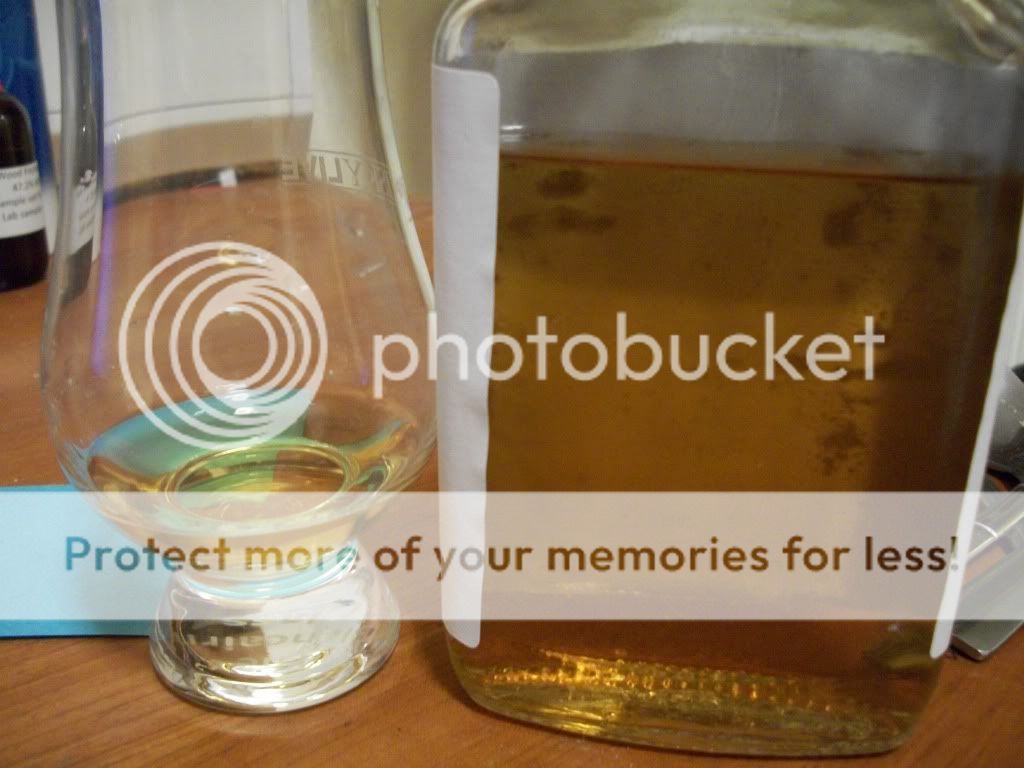
Literally a blank bottle. The label I put on there to keep me from confusing it with a blended scotch I had.
Here is a picture of the sample bottle. You find, when you start receiving samples, you get two kinds of samples. One sample is the full bottle, picture pretty. It's nice but I rarely need a full bottle, unless its something that I want to tinker with in drinks or in high balls. The other...is the random sample. Bottles of all shapes, sizes, and previous uses. I've gotten stuff in Ball jars, TSA approved plastic shampoo bottles (clean), small vials that distinctly would look like drugs if it hadn't had a picture of the bottle laminated on with clear tape, and all sorts of miscellany. I like them better. They got character; pizzazz. I won't lie. I give the samples that come to my door a rating on the ol' pizzazz scale. But I digress. Here's the notes.
Nose: Almost rum-like. Heavy molasses. Touch of sulfur and a little pot still funk, like a Jamaican rum. Nice fruit bouquet in there: pineapple, mango, exotic fruits.
Taste: Mango and pineapple. Watermelon? Raspberries too. Definitely a fruity spirit. Almost like a fruit infused honey. A little hot and prickly on the finish but overall agreeable. Tim LIES. It's quite good.
I am intrigued. To be honest, I've never had arrack before and I was a little scared when Tim said that it was pretty rough and tumble but it's a fine beverage. Would I buy it? Sure would, depending on the price. It's an import so import taxes can be a bear but I could see myself putting down $20-$25 for a bottle to see what concoctions I could make with it. I think the crux of the spirit is the fact that it has NONE of the traditional malt characteristics and, since it uses a sap as it's fermentation bill, it's got a whole lot more chemical processes to go through, resulting in different flavors. And the fruit forward nature of it, with such intensity, makes it pretty cool.
Bear in mind that this is the batch from...gosh...almost a year ago so things may have changed. But I can't see it changing much more. Ignore Tim's "warning" that it's an "unrefined" product. S'good. And trust me Tim, I've had MUCH more unrefined stuff. Like distilled Olde English 800.
Working at a distillery is powerful thirsty work. Shoving and jockeying barrels, standing next to steam jacketed copper stills, crawling into odd, dusty places to plug stuff in or unscrew something. Powerfully thirsty work that leaves a man with the need to imbibe in great quantities. Most often when I get home, I'm craving a cold beverage and to take off my boots (insulated Red Wing boots...so sweaty). Lately, I've been drinking a melange of different beverages, my two favorites being grape soda and Virgil's Dr. Better (a significant upgrade to Dr. Pepper). But I recently came across more cans proudly displaying that lovably homicidal grandma, so I figured I'd pick them up to try what else ol' Sweet Leaf has to offer. This time, it's their Sweet Tea:
Do you like the strategic placement. It's a very zen can.
While I tend to like my sweet tea like tea flavored simple syrup, this stuff is solid and it's clear that they're not trying to trick you on the ingredients list. The black tea is plain but robust and slightly tannic. The cane sugar is present, although not in a concentration that I'd prefer, and it interweaves with the tea nicely. The beverage is crisp and clear and each element is easily identifiable in each sip. While the tea itself is your standand orange pekoe or maybe a CTC assam, it's good in its own thirst quenching way. The kind of thirst quenching that makes you drain the can in one gulp and crush it with your fist when you're done. And for $.89, I'd buy it and do it again. And next time, in a larger quantity.
But only if someone puts painter's tape over that grandma face. Jeez, that lady is SCARY.
Lately, I've been thinking about things. Weird, right? Well, the proverbial smoke has been pouring out of my ears like a locomotive. The topic at hand? Surely something deep and profound. Something that would make Freud weep, give Plato restless nights of worry, and Sagan...well...Sagan wouldn't do anything. That man's unflappable. Like stone. Something philosophical, right? Nope. It's mainly been:
"What the HELL am I doing?"
To be fair, I think it's a pretty important question. Six years ago I thought I'd be going to Cornell and working for Intel as a Chemical Engineer. Now...I work at a distillery as a MSc in Brewing and Distilling Science. How did this happen? What frantic tapestry was woven to result in this? Well, I think it's time we had a flashback session on In With Bacchus. So think of this as a new Fireside Chat with FDR. Only FDR is as sodden with booze as a rum cake.
So where do we begin. Well, let's begin with this man:
That man is Mark Davidson. When I was a wee lad...alright, not so wee. I was 18/19 and I was in, surprise surprise, Edinburgh for vacation. My mother, deciding that she'd like to spend a lovely night in the creepy-as-hell plague crypts under Edinburgh known as Mary King's close, left me to my own devices in a land where I was of legal drinking age and surrounded by pubs. Did I get blackout drunk? Not quite. Knowing full well that she wanted to spend the night enshrouded in the creepies, I decided to enshrine myself in the scotchies for a night. While walking down the Royal Mile, I spied W.M. Cadenhead's and a sign for a blind scotch tasting on that very night. For about £15, I got the schooling of my life. Where I had broken my drinking teeth on Captain Morgan, Bacardi 151, and Johnnie Walker Black...this man came up to me with five glasses of upside-the-head. We tasted some Nikka Coffey Still, Ardbeg Corryvreckan (the 2008 Committee Bottling!), and a Michael Couvreur Bere Barley Single Malt, along with two others that my brain has unfortunately misplaced. It opened my mind to the fact that there was so much more in spirits that I hadn't even fathomed. Ol' Mark Davidson planted the distilling seed. But who helped it flourish? This guy:
That...is Truman Cox. Former Lead Chemist for Buffalo Trace (now Master Distiller for A. Smith Bowman in Virginia). I managed to get talking to him about his background as a chemist and how he got into the industry. We talked via email for a good few months, just discussing things, when I finally realized that my unhappiness with my undergraduate degree (Chemical Engineering) could be turned into something much, much better. So I posed the ultimate question: where can I go from here. And he recommended Heriot-Watt for my masters. To Mr. Cox, I owe a great deal. He helped me turn a life of mind-numbing monotony (that I wasn't particularly good at) into a veritable Wonka-land of awesome. But, I'm sure dear reader, you're wondering how I found out about what many would consider a relatively obscure (but major) player in the spirits industry. For that, I introduce this man:
I heard about Truman Cox through this man's podcast, Whiskycast. Some know him as Mark Gillespie. This is true. I know him as "You can be a whisk(e)y journalist?!" He was the man that partially inspired me to start this website. His podcast and website chronicle almost everything he's ever tasted and he shares them with the world. I thought that was a pretty sweet idea that killed three birds with one stone. Improve my palate (after all, Mark Davidson taught me that there's a big world out there), keep a tangible record of what I've liked/disliked, and get feedback from friends. I actually first listened to Whiskycast back in 2006 (I was only 19! Gasp!) and began to listen to it in earnest in 2008, shortly after my whisk(e)y revelation and about a year before I started the blog. While the Jolly Toper (Mark Davidson's whisky slinging alter ego) made a crack in the foundations of my whisk(e)y ignorance, Mark Gillespie and his Whiskycast put a wedge in there and hit it with a hammer. Only by "put a wedge in there" I mean "bought a wrecking ball" and by "with a hammer" I mean "with a wrecking ball". In my younger days, I couldn't even fathom what whisk(e)y meant. The subtle nuances of cask choice, of condenser type, of still design, of column and pot still blend choice. Mark opened the door to both whisk(e)y journalism and the technical side of manufacturing whisk(e)y for me. Heriot-Watt served to re-lay the foundation of my whisk(e)y intelligence. The man who finished the house, and who I have quite a deal of respect and admiration (not to mention owe quite a bit), is this man:
This is Dave Broom, eminent spirits writer and knower of many things. He managed, straight out of school, to introduce me to my editor at Whisky Magazine and help me get published in such a prestigious tome. Not only that, but he tolerates my occasional calls to ask him about obscure spirit things. To sum it up, Dave has done two things: pushed me further into whisk(e)y journalism...and broadened my horizons to spirits journalism. For a long time, my focal point was whisk(e)y. Scotch, Irish, American, Japanese. I reveled in it all. But his continued conversations and articles about traveling to Japan for sake and shochu, his depth and breadth of knowledge of rum, and his wisdom on cognac have made me realize that I'm being too shortsighted in my work. Because of him, I'm seeking out rum to try, sake to sample, and (for the first time ever) I'm contemplating broaching the subject of cognac, which I know only in technical terms but not in flavor or aroma.
These men, legends in their own ways within their industries, shape what I do on a daily basis. There are others, however, that shape HOW I do it. My writing style can be said to be...unique. "Crazy" is more often the appropriate term; the rantings of mercury-laden hatter. But I do draw my style from a few sources. To some extent, I draw influence in my writing methodology from my engineering background. Frankness and truth are well regarded in my writing. There is no gilding of the lily in the sciences: you are either wrong, or right until someone proves you wrong. Being forthright is key. But that's not to say that don't incorporate other facets. One of my main figureheads of journalism is this man, the most reverent (and crazy) of them all:
Dr. Hunter S. Thompson. Raoul Duke. The Grand Pubaa of Crazy Journalism. Many of my generation enshrine the Good Doctor due to his prodigious and grandiose usage of illegal substances (in vast quantities and inappropriate times). While I find this entertaining to a certain degree, it's not what draws me to him. It's his style of writing. Gonzo journalism, as defined by Wikipedia, "is a style of journalism that is written without claims of objectivity, often including the reporter as part of the story via a first-person narrative." It is journalism at its extreme opposite. Instead of the journalist remaining distanced and observing, it sees the journalist immersing and interacting. While this may be horrid for your standard (read: important) news, I find in the spirits industry that it's a most beneficial and beautiful form of coverage. They say that you can't know a man until you've drank with him and I feel that doing it gonzo is the only way to fit that pearl of wisdom into a journalistic setting. To be fair, I don't go as far fledged as the Good Doctor did (although if funds weren't limited all the time, I most certainly would go full gonzo), I do try to adhere to what Hunter S. Thompson has created with his time. Also, his writing style is impeccable. If you saw the Rum Diary with Johnny Depp, try reading the book. I haven't even seen the movie and I can tell you its better. Don't feel bad about perusing Thompson's works; they're very, very good.
My other inspiration for writing may surprise some of you. It is a man that made his bones elsewhere in another industry and decided to write a book about it. His work is the quintessence of the phrase "write how you talk."
The man is Anthony Bourdain. I greatly admire his works (Kitchen Confidential, Nasty Bits, Medium Raw). Upon reading those books, its as if the man is sitting next to you, narrating it to you like an episode of No Reservations. His uncanny wit, scathing sarcasm, and almost venomous self-depreciating humor come across exactly as he speaks. And it is ungodly beautiful. He can spin a true story like no other I've met. It is poignant, funny, and particularly jabbing. I likes it. So, naturally, I'm borrowing it. Except I'm no great artist, so I think I just proved Picasso wrong. So HA, you Spanish Cubist genius. Not so genius after all, huh?
This is, of course, the short list. I could name dozens of others who I greatly admire and draw infrequently on (this post itself contains several references to another comedic savant, Brad Neely) but I'm pretty sure I lost most of you about 3/4 the page up so I won't go any further. I just wanted to put this out there not just to enlighten you, but to thank those that have inspired, guided, and helped me to be what I am. Maybe in ten years time I'll do another post like this (assuming we're still using blogger, or even computers) and update my list. I'm sure that as time rolls inexorably forward, this list will grow significantly longer.
At work, there always constant chatter about the TTB. The Tax and Trade Bureau, which regulates labeling and classification of distilled spirits, is the gateway for the small distiller to go from crazy idea to commercial product. You submit your formula (recipe), your label, your wine gallons, your proof gallons, your losses in rectification, and even your soul to these people and they make sure that your product is legal to sell, with the appropriate documentation, and that you're paying applicable taxes.
One of the things that they do is classify what your spirit is. They determine whether what you've made is a whiskey, a flavored vodka, bitters, or what have you. You have to meet certain legal qualifications for all of these categories and you'd be surprised how lenient they can be. You can put new make corn whiskey, distilled to no higher than 160 proof, into a new charred oak barrel at no higher than 125 proof for 1 second...and it would be called a bourbon. "Bourbon" doesn't have a mandatory time-in-barrel. "Straight bourbon" does; it's 2 years.
But there's always been one thing that's bothered me: should sugar jack be classified as a rum? For those of you that don't know what a sugar jack is, I turn to one of the two foremost experts on all things moonshine, Matthew Rowley. In his post "A Writer's Guide to Moonshine, Part 1", he goes on to say this:
"In the mythological mountain South, that pure old mountain dew was corn
whiskey. But even in 1974, actual journalist Joe Dabney realized that
style of moonshine was on the wane, replaced by modern sugar washes that
distillers took up in widespread corner-cutting in the 1920’s. In Mountain Spirits,
he wrote “The truth is that compared to equivalent figures from five,
ten, and twenty years ago, the ‘corn likker’ craft is dying fast.” No,
what was around for most of the last 90 years was not corn whiskey at
all, but spirits made from table sugar, made fast to be sold fast. The
old corn whiskey of our parents’ and grandparents’ eras was rarely corn
and rarely whiskey. But it sure was moonshine."
A sugar wash is literally described by its title: a mixture of table sugar and water, fortified with yeast nutrients, that is fermented and distilled. There are a few places these days creating a sugar wash moonshine (the one I'm thinking of is the new Dutch's Spirits which makes a Sugar Wash Moonshine out of Demerara sugar.But one thing that's irked me is, if you were to submit it to the TTB...would you have to call it a rum?
Personally, I feel that a sugar jack shouldn't be classified as a rum even though its fermentation base is sugar, like all rums. But here's why. Rum itself is mainly made of byproducts of the sugar manufacturing process. Your standard molasses based rums, regardless of molasses grading, are manufactured using a byproduct of the sugar rectification process. Even rhum agricole (which is made using cane juice), I feel, is made with a byproduct as there is little commercial viability for fresh cane juice. You can't really export cane juice without heavy processing. Most rhum agricole producers are within an hour or two of a sugar cane pressing site. The reason for this is the biological instability of cane juice. Molasses is hard to inoculate in its uncut form due to the high sugar content. Any bacteria or yeasts that are added to pure molasses rarely survive due to what's known as osmotic pressure. If I can hearken back to basic chemistry here, you may remember that things of high concentration flow to areas of low concentration. In molasses, the high concentration of sugar outside of the cell membranes of the yeast/bacteria really wants to get into the low concentration area within the cell of the yeast and bacteria. This osmotic pressure will eventually draw the water out of the cell to balance the outside and inside concentrations, effectively killing the cell. But in cane juice, there isn't a high enough concentration of sugar to do this. In fact, its the perfect concentration of sugar to facilitate bacteria and yeast growth. So without heavy processing (read: drawing off water to form a syrup), it is useless. A sugar jack, however, is using a non-waste ingredient. It's taking the refined sugar, either white table sugar or refined brown sugar, and using it as a fermentation base. If you've seen Moonshiners, you've seen Tim hauling around big bags of sugar to supplement his corn fermentation. This is the main difference between a rum and a sugar jack: one uses a waste product, the other uses a finished product to achieve a high alcohol wash.
Do I think the TTB will open up a new category for sugar based moonshine-like products? No. Do I wish they would? Yeah. I think lumping it in as a rum is doing it a disservice. Even if it's not a 100% pure sugar wash, I still think there should be some wiggle room here. A 51/49% mix of corn to sugar doesn't really make a whiskey, nor does it make a rum. It makes an entirely different animal. But, hell, for all I know they could be classifying it as a vodka. The Standards of Identity for Distilled Spirits is a funny thing. And I spent months studying it.